
Open End Polyester Cotton Yarn or Ring Spun? Choosing TC Yarn for Heavier Fabric
Fabric mills that make workwear twills, canvas-type casual cloth, heavy knits, socks and sweaters often reach the same question when they set up a new polyester/cotton quality: should the yarn be open end polyester cotton yarn or ring spun? Both routes start from the same polyester and cotton fibers, but they build the yarn in very different ways, and the choice shows up in the hand, surface, strength and cost of the finished fabric.
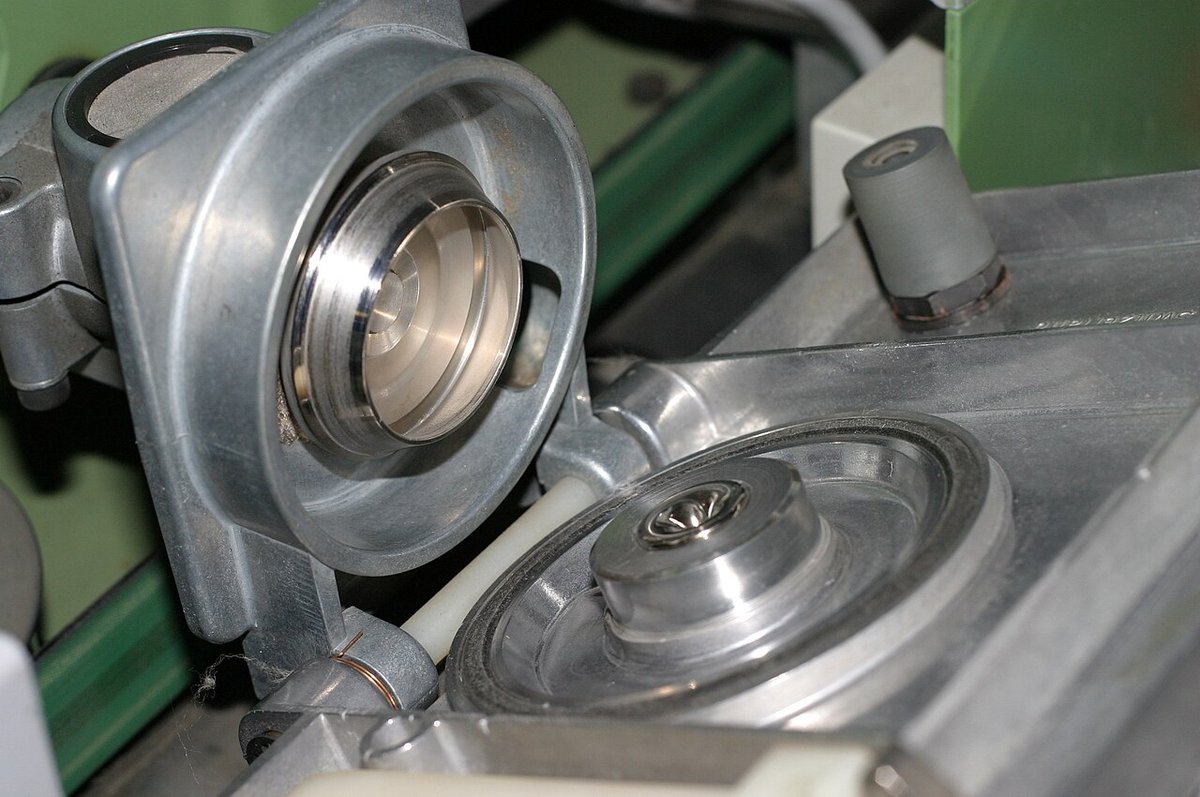
Rotor spinning unit. Photo: Ikiwaner, CC BY-SA 3.0, via Wikimedia Commons
How Open End and Ring Spinning Build a TC Yarn
Ring spinning drafts the roving into a fine strand and inserts twist with a traveling ring and spindle. The fibers lie mostly parallel and are twisted tightly together, which gives a strong, soft yarn with a wide count range.
Open end (rotor) spinning separates the sliver into individual fibers, feeds them into a fast-turning rotor and pulls the yarn out continuously. The yarn has a core of twisted fibers wrapped by looser surface fibers. It is most at home in the coarser count range.
In a polyester/cotton blend, polyester brings strength and shape retention, cotton brings a natural hand, and the spinning route decides how both show in the cloth.
Open End Polyester Cotton Yarn: Where It Fits
Open end polyester cotton yarn is a practical choice when the fabric quality is coarse and the priority is an even, full-bodied yarn at an efficient cost. Typical points buyers mention:
- Good evenness in coarse counts. Rotor yarn tends to look regular along its length, which helps heavier fabrics keep a uniform face.
- A fuller, slightly firmer hand. The wrapped structure gives bulk and cover, useful in heavier knits, socks and woven goods.
- Efficient for heavier fabric programs. Rotor spinning is a fast, short process for coarse counts.
The trade-off is that open end yarn is generally less strong and less soft than ring spun yarn of the same count, so it is not the route for fine shirting.
Jiangyin Tonghe Yarn Industry Co., Ltd lists colored open end TC yarn in coarse counts. The Ne 12/1 open end polyester cotton yarn is used for knitted and woven fabrics, socks and sweaters, and buyers state the blend ratio they run, such as 65/35 or 50/50. For very heavy products there is also a much coarser Ne 0.5 50/50 polyester cotton open end yarn. The full range is in the open end yarn category.
When Ring Spun TC Yarn Is the Better Choice
Ring spun polyester cotton yarn is the usual pick when the fabric needs more strength, a softer hand or a finer count. The mill's colored ring spun yarn sells mostly in the Ne 16 to Ne 30 range, and the Ne 20/1 65/35 polyester cotton yarn is a standard mid-count item. Browse the ring spun yarn category for other counts.
There is also a third route. Ne 30/1 65/35 polyester cotton vortex yarn is chosen when a cleaner surface and lower pilling matter, for example in knit fabrics that are washed often.
A simple rule: if your fabric quality is already written for a spinning method, keep it. Changing from ring to open end, or the other way, changes the fabric and should be sampled first.
Color: Why Dope Dyed TC Yarn Helps Heavier Fabrics
Heavier fabrics use more yarn per meter, so shade differences between lots are easy to see. Jiangyin Tonghe Yarn Industry Co., Ltd, founded in 1995 in Jiangyin, Jiangsu, China, runs its own chemical fiber plant and spins colored yarn from dope dyed (solution dyed) fiber. The color is built in before spinning, which helps reorders stay close to the approved standard and lets the fabric skip a piece-dyeing step.
The largest-volume shades are black, heather greys, navy and royal blue, which are also core workwear and sock colors. Regular colors are in stock with no minimum order quantity. Custom colors are sampled against your swatch or target fabric and have a minimum order of 10 tons.
What to Put on the Order Sheet
Write the count, blend and process in one line, for example "Ne 12/1, 65/35 polyester/cotton, open end" or "Ne 20/1, 65/35 polyester/cotton, ring spun". Then add the shade, the end use (knitting, weaving, socks or sweaters) and the quantity. Ask for a sample cone or a fabric panel before bulk. Standard packing is PP woven bags or cartons, payment is by T/T or L/C, and shipment can be by sea, land or air.
FAQ
Q: Is open end polyester cotton yarn weaker than ring spun yarn?
A: Generally yes, at the same count. Open end yarn is chosen for evenness, bulk and cost in coarse counts; ring spun yarn is chosen when strength and a softer hand matter more.
Q: Which blend ratio should I order for open end TC yarn?
A: Follow your fabric quality. 65/35 and 50/50 are common; tell the mill the ratio you already run. The Ne 0.5 open end item is listed as 50/50.
Q: Can I get open end TC yarn in custom colors?
A: Yes. Regular colors are in stock with no minimum order quantity, and custom colors have a minimum order of 10 tons.
To compare open end and ring spun options for your next program, send your count, blend and shade to Jiangyin Tonghe Yarn Industry Co., Ltd at sales@thyarn.com or WhatsApp +86 18800588573, or visit the contact page.